The Authority Gap: Rewriting UK Tech Profiles So Women’s Expertise Leads

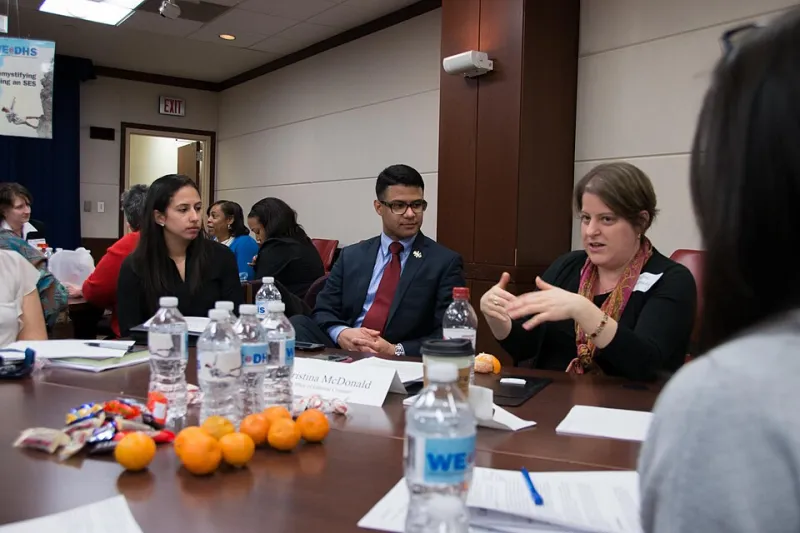
Photo: professional woman technology leader speaking at UK conference, via c8.alamy.com
Profile copy is often treated as housekeeping: a paragraph to be drafted late, approved quickly and forgotten. In UK tech, that assumption is costly. A speaker bio, a leadership page and a directory entry are now part of the infrastructure through which credibility is assessed. They are read by hiring managers, conference programmers, procurement teams, journalists and, increasingly, automated search tools. When women’s profiles are written with vague praise and junior framing while their peers’ profiles are written with scope and evidence, the effect is not neutral. It is an authority gap.
The pattern is not a hunch
Audit a set of UK tech leadership pages and speaker biographies and a familiar asymmetry appears. Men are more often described through what they own: the platform they scaled, the budget they controlled, the regulatory programme they led, the engineering organisation they built. Women are more often described through temperament: passionate, dynamic, collaborative, energetic, dedicated. These are not disqualifying words. They are simply not substitutes for information. A profile that says a woman is passionate about digital transformation tells a reader less than a profile that says she led a data platform serving twelve million customers through a regulated migration.
The asymmetry is not always deliberate. It often emerges from a chain of small edits: a communications team softening a sentence, a woman self-editing to avoid the charge of boastfulness, an event organiser reaching for a warm adjective because the submission form asked for a short biography rather than a professional case. But the cumulative result is a market in which women’s expertise is less legible than it should be.
Likeability is not a proxy for authority
Vague praise creates a specific problem in the UK context. Understatement is culturally valued, and many women in tech have learned to present achievement as good fortune or collective effort. That instinct is understandable. It is also exploited by profile formats that reward likeability over evidence. When a leadership page describes a woman as a ‘great people person’ but does not mention the size of the organisation she runs, the reader is invited to infer warmth rather than competence. When a speaker bio calls a senior engineer ‘one to watch’, it introduces a developmental frame that would be unusual for a peer with equivalent experience.
Event organisers should pay particular attention here. A conference biography is not a character reference. It is a briefing document. It should tell an audience why this person can speak with authority on the stated topic. If the bio does not do that, the panel may still be excellent, but the framing has already made the woman’s expertise harder to see.
The junior framing problem
Verb choice matters. Profiles of women in UK tech still contain a disproportionate number of ‘supported’, ‘assisted’, ‘contributed to’, ‘was involved in’ and ‘helped to deliver’. The same roles, when described by peers, become ‘led’, ‘owned’, ‘built’, ‘scaled’, ‘negotiated’ and ‘accountable for’. Accuracy must come first: if a woman co-led a programme, the profile should say co-led. But co-led is not the same as supported, and ‘involved in’ is rarely a useful description of senior work.
Junior framing also appears in titles and introductions. ‘Rising star’ and ‘emerging leader’ can be appropriate for early-career professionals, but they are sometimes attached to women with fifteen years of delivery behind them. The fix is not to inflate language. It is to use the same descriptive standards across a cohort. A profile should state the remit, the scale and the outcome. Warmth can follow. It should not be asked to carry the evidential load alone.
Missing technical scope is missing evidence
Many women’s profiles omit precisely the detail that makes technical authority portable: systems owned, platforms supported, team sizes, budget responsibility, regulatory regimes, languages and frameworks, product domains, research methods, security clearances or governance roles. This omission is often framed as modesty. In practice, it removes the searchable, comparable evidence that employers and event programmers use to make decisions.
A directory profile has a particular duty here. ICT Women Directory exists to make women’s expertise easier to find, not merely to celebrate their presence. That means entries should be built around domains and scope, not adjectives. A profile that lists cloud migration, data governance and team leadership is more useful to a reader than one that lists ‘passion for technology’. The first can be searched, cited and matched to an opportunity. The second cannot.
A 2026 rewrite checklist
For women in UK tech:
- Open with domain and scope: what you do, at what scale, for whom and with what accountability.
- Replace adjectives with evidence verbs where you can defend them. Keep one or two human notes; do not let them crowd out the substance.
- Name platforms, methods, standards, regulatory contexts and technical domains that are relevant to your work.
- Quantify only what you can substantiate. Ranges and clear ownership are better than inflated precision.
- Remove junior framing unless it is accurate. Use ‘co-led’ where it is true, but do not accept ‘supported’ for work you directed.
- Add public work that demonstrates expertise: talks, publications, open-source contributions, standards work or board roles.
- Ask a trusted peer to redline the profile for both authority and accuracy.
- Keep a master profile and adapt it for directories, speaking and leadership pages without diluting the evidence.
For employers:
- Audit leadership pages by verb and scope, not by impression. Compare cohorts and correct asymmetries.
- Standardise fields: remit, team size, budget, technical domains, regulatory exposure and outcomes.
- Train communications and HR teams to spot gendered language that substitutes temperament for competence.
- Give women final approval and, where possible, a byline on their own profiles.
- Review job titles and promotional language for senior roles so that ‘supporting’ does not become the default description of leadership.
- Publish technical scope alongside organisational ethos. Credibility is built from both.
For event organisers:
- Provide a biography template that asks for domain, scope and the specific topic the speaker can address.
- Reject vague praise as a substitute for evidence, politely and consistently.
- Brief compères to introduce expertise, not likeability.
- Check panel and speaker pages for asymmetry before publication.
- Maintain a reviewed 2026 bio bank and revisit entries quarterly.
- Use directory-style fields so that speakers can be found by expertise, not only by name.
What good looks like
A weak profile says: ‘Passionate technologist supporting digital transformation across the organisation.’ A stronger profile says: ‘Head of Data Platform at a UK financial services firm, leading a team of 28 engineers and accountable for a regulated migration serving twelve million customers.’ The second version is not boastful. It is specific. It gives a reader something to assess, a programmer something to brief and a search tool something to match.
The authority gap will not close through a single rewrite. It will close when women, employers and event organisers treat profile copy as part of the evidence base for UK tech. In 2026, that means writing profiles that signal expertise before they invite affection. Warmth is welcome. It should not be the only thing a reader can find.